
At this moment, we are documenting the entire ROILA project. Soon we will provide this information. It will also include details about the ROILA curriculum and the controlled experiment that we conducted at the Huygens College Eindhoven.
You are currently browsing mubin’s articles.
Tags: ROILA documentation
As an exercise we translated the Asimov Laws of Robotics in ROILA. Alternate translations/comments are welcome.
Law 1: A robot may not injure a human being or, through inaction, allow a human being to come to harm.
Jewomo kilu. Lobo waboki buse nijofa losa bebibe jilufe buno buse jilufe.
Law 1. Robot must no damage man through act or no act.
Law 2: A robot must obey any orders given to it by human beings, except where such orders would conflict with the First Law.
Jewomo seju. Lobo waboki nomes jilufe sojan fumene tuji bufo jifi pofan losa kenet similu bopup jewomo kilu.
Law 2. Robot must take act any order(s) give(n) by man, if agreement with Law one.
Law 3: A robot must protect its own existence as long as such protection does not conflict with the First or Second Law.
Jewomo tewajo. Lobo waboki pisal jalawe bamas fenob fomu takanu kenet similu bopup jewomo kilu sowu jewomo seju.
Law 3. Robot must make safe this life of self, if agreement with Law 1 and Law 2.
Tags: Asimov Laws, ROILA translations, translation
Recently we concluded the first ever ROILA course at the Huygens College Eindhoven. The course lasted for three weeks and was taught to 100 Dutch high school students students spread over 4 classes. The lessons involved practicing ROILA and playing with LEGO robots. All of us (teachers and students included) had alot of fun. So much so the school wants to make it a permanent part of their Science curriculum. They plan to do a repeat of the course for another class in January next year. A follow-on controlled experiment was also conducted which compared the efficacy of learning ROILA to control a robot vs controlling English-savvy robot. ROILA was found to better on both subjective and objective accounts (details coming soon).
We would like to thank the staff and teachers of Huygens College Eindhoven for their support and appreciation. Needless to say the children deserve a special mention too.
Tags: Huygens College Eindhoven, ROILA
We will be continously updating the ROILA academy section as we progress with the ROILA course at Huygens College, Eindhoven. Please visit the academy to know more about the course and our efforts at the school.
Tags: Huygens College Eindhoven, ROILA course, ROILA lessons
The first set of 10 ROILA lessons are now uploaded in the ROILA academy. This set is the first version and may be subject to slight revisions. Please feel free to join the ROILA academy which is setup in Moodle. Also uploaded is the relevant glossary for these lessons, both here on the website as well as in the academy on Moodle. Alternatively you might want to have a look at the HTML version of the lessons. We would like to acknowledge the contributions of Jerry Muelver towards the design of the lessons. Please let us know if you have any comments or would like to give us some feedback.
The entire ROILA audience is welcome to study the ROILA lessons. If you are interested in subscribing to the academy please send us an email with your name and location so that we can make an account for you.
Tags: lessons, ROILA course
We are busy implementing small scenarios/concepts for students of ROILA so that they can interact with Mindstorm NXT robots while talking in ROILA. One of them is a simple shooting game, where we wanted to get the color sensor to work. However the “new” color sensor in Mindstorms NXT 2.0 does not work with lejos NXJ 0.8 and neither with some versions of 0.85. Please use the following classes.jar file to make your sensor work, courtesy of the lejos team. Remember to replace your old version of the jar file in two places: lib folder in the projects folder and lib folder where you installed lejos. A simple replace worked for us and we did not have to rebuild any code. But, remember to download your java program on the NXT again.
Tags: Color Sensor, Lejos, Light Sensor
At this moment we are busy designing lessons for ROILA. These lessons will be used by high school students to learn ROILA in our upcoming project. We are using Moodle an open source e-learning tool. Moodle provides various functionalities and features which make designing lessons fun and simple. One of the interesting challenges that we are contemplating is how to provide a dictionary or a glossary with audio pronunciations of ROILA words. An alternative could be to accomplish this externally using word press on the ROILA website (see first version). We aim to use Text to Speech recordings as the sample pronunciations for ROILA as that would be consistent and efficient. The recognition accuracy of the TTS sentence recordings was found to be very high (just 1 word error in about 120+ words) for a list of 30 sentences. This figure was generated by passing recordings offline in the Sphinx-4 recognizer.
Tags: Moodle, ROILA lessons
We are extremely pleased and grateful that Christiaan Huygens College Rachmaninowlaan in Eindhoven has agreed to cooperate with us in the ROILA project. Children from third grade (14-15 years old) will be learning ROILA and using it to play games with LEGO robots. This activity will be part of their Science Class and we expect the ROILA learning to last for 3-4 weeks with a final one week used for the evaluation and game play. As a token of appreciation we will be donating LEGO Mindstorms NXT kits to the school.
We are extremely pleased to welcome two additional members to our team who will be helping us in this project. Hanneke Hooft van Huysduynen (Final Year Bachelor Student at Industrial Design, Eindhoven University of Technology) will be helping with the design of the game(s) and the execution of the study. Jerry Muelver (President of North American Ido Society, Inc) is assisting us by designing the ROILA lessons and lectures. We welcome his expertise with artificial languages and conlangs.
We will post updates and details as soon as they become available.
Tags: children, Evaluation, High school
Ubuntu users will find it quite easy to install and use Festival for Text to Speech. The following link gives the details:
We would strongly recommend to use Ubuntu to run TTS. Compiling and building Festival on Windows is quite a task. All of this means that ultimately we are faced with two choices when implementing a complete application for ROILA, since we had configured the Lejos NXT platform on Windows.
- Setup lejos on Ubuntu, including Bluetooth support.
- Use the text2wave utility in Festival to generate wav files on Ubuntu. These wav files can then be played from within Java when running NXT programs on Windows.
We have prepared a simple script that generates wav files of any number of sentences written in a text file using approach 2. Of course the disadvantage is that TTS is done offline and one would need to know beforehand the plausible list of sentences that the NXT robot could say. If someone has hands on experience with approach 1 please let us know.
Tags: festival, text to speech, Ubuntu, Windows
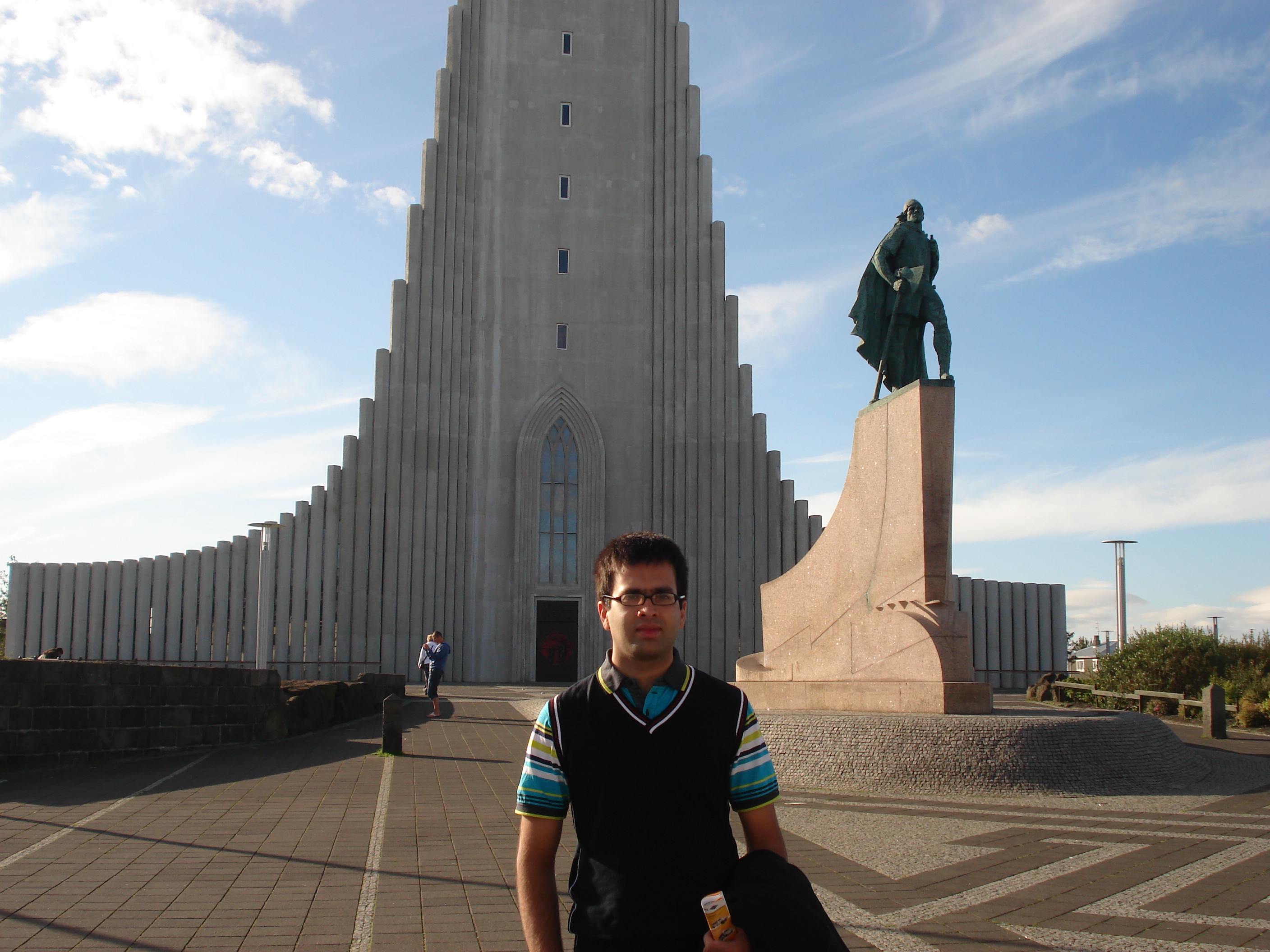
We were pleased to be a part of the IceTAL 2010 conference in Reykjavik, Iceland, where we presented our work on ROILA. The published version of the paper is now available in the publications section. Needless to say we also had great fun exploring Reykjavik and the natural beauty of Iceland (see pictures below of the Church of Hallgrímur, the Gullfoss Waterfall and the Strokkur Geysir).


Tags: Iceland, IceTAL 2010, Reykjavik